The process for filing disability under all three state systems is quite similar. To file, you would contact your retirement system and ask for a disability application packet to be sent to you (the OPERS application is available online at www.opers.org/disability). All applications require that your Attending Physician certify your disability on a specific report form and that your employer complete a report regarding your prior employment. You will also need to provide information regarding your disability and why you feel you are unable to continue working. If you have worked in more than one of the three systems, you must file in the system where you have the most credits. The time requirements for returning the parts of the application are very important and must be complied with or your application may be dismissed. Once the retirement system receives your application, it will be forwarded for review by their medical review organization. You will be asked to be examined by a physician of their choosing. That physician will make a recommendation as to whether your benefits should be approved or denied. Ultimately, the retirement board will vote to accept or deny your claim and you will be notified of this decision, in writing, by mail.

You have extremely short deadlines for filing appeals of these claims if they are denied. You do not want to delay in contacting representation if you are denied, and we recommend retaining counsel prior to filing your application to put you in the best position for submitting a complete and appropriate disability application. You are entitled to one appeal of a disability denial, which goes before the retirement board. If that appeal is denied your options are either to pursue the claim into Court or, if you have time within the one or two-year filing requirement, to file a new claim alleging new disabling impairments or worsening of a previously alleged impairment.

School Employees Retirement System of Ohio Disability Claims: There are two plans for disability benefits with the School Employees Retirement System of Ohio – the New Plan (for those who became members on or after July 29, 1992) and the Old Plan (for those who were members before July 29, 1992, unless you exercised a one-time option to switch to the new plan.) Under the Old Plan, you must file for disability prior to age 60. Under both plans you must have 5 years of service credit to file for disability and you must file your disability application no more than 2 years from the date that your contributing service ended. You must have a condition or conditions that prevents you from working in your own SERS-covered job. Moreover, you will not be eligible to file for disability for any condition that resulted from your commission of a felony or that occurred after your employment ended. You will also be ineligible to file for disability if you withdrew your funds from your retirement account or elected to receive a service retirement benefit. Once your complete application package is received by SERS, they will contact your employer to obtain information on your most recent job duties and payroll information. After sending you to see an SERS-appointed doctor, the SERS retirement board’s medical advisory committee or the chair of the committee will review the doctor’s report and your complete application package and make a recommendation to the Board either to approve or deny your claim. Under current standards, you are provided 15 days from the date on the notice of denial to file your notice of intent to appeal the Board’s decision. The Board then must receive your additional evidence in support of the appeal within a specified period of time. You may request a personal appearance before the board with legal counsel and/or your doctor – but this request must also be submitted within 15 days of the Board’s denial of your application.

State Teachers Retirement System of Ohio Disability Claims: There is also an old and a new plan for disability in the STRS system based on whether you were a member before July 29, 1992. For anyone hired after June 30, 2013, you must have at least 10 years of qualifying service credit with STRS. In Ohio, in order to be eligible to file for disability, your application must be received within one year of the last date you contributed to service in any of the three state retirement systems. If you were a member on or before June 30, 2013, you need only have 5 years of qualifying service credit and you are given two years to file a disability application. You must also file your application before you turn age 60 and not be receiving service retirement benefits. In order to be eligible for disability benefits – you must have a medical condition or conditions that prevents you from performing the duties of your occupation as a teacher. Once you receive the application package from STRS, the Report by Employer must be returned to STRS with a copy of your most recent official job description. The attending physician statement must be completed by a medical doctor (M.D.) or a doctor of osteopathic medicine (D.O.) – a report from a nurse practitioner or a psychologist will not be acceptable. That doctor must have examined you within the last two months. Your doctor must certify that your medical condition is and will continue to be disabling for at least 12 months from the date STRS receives the application. For applications received on or after June 7, 2019, the doctor must be a medical specialist – that is – not a primary care physician, but someone who has completed further education to specialize in the treatment of your disabling condition. If your application is denied, you have only 15 days from receipt of the denial notice to submit notice of your intent to appeal with notice that you intend to submit additional medical evidence contrary to the findings of the independent medical examiner(s), as well as notice if you are requesting an in-person appearance before the board, with or without legal counsel. You will then have a short period of time to submit your additional medical evidence after your notice of intent to appeal is filed. If your appeal is denied, your recourse is to file a claim in Court or, if you have additional time remaining, to file a new claim alleging a new disabling condition or worsening of a previously alleged impairment.

Ohio Public Employee Retirement System Disability Claims: Under this system, an applicant has two years from their last date of contribution to file an application for disability benefits. If you apply for disability benefits on or after January 7, 2013, then your application will initially be evaluated under an “own occupation” disability standard – meaning whether you are physically or mentally incapable of performing the duties of your last public employment position. Your condition must be permanent (that is defined as expected to last for a continuous period of at least one year following the date of filing.) You will continue to be evaluated under the own occupation standard for the first three years you receive disability benefits (if your claim is approved.) However, after three years, OPERS will review your claim under an “any occupation” standard and you will have to show that your medical condition(s) prevents you from the duties of any position that you are qualified to do, reasonably found in your region, and that replaces at least 75% of your inflation-adjusted final average salary (FAS). If you are filing under the Original Plan (a member before July 29, 1992) Group A or B, you must file for disability before age 60. If you are in the Original Plan Group C, you must file for disability before age 62. If you are in the revised plan, you can apply at any age. If your claim is denied, you have 30 days from the date of notice of denial to appeal the decision. You then must, within 45 days, submit a completed Report of Physician along with additional objective medical evidence in support of your appeal.
Update: A semblance of normalcy is returning to litigation and legal issues throughout the country. Once dormant, litigation is slowly returning to a more normal status. As before, Social Security disability hearings continue to occur, mostly by telephone. The administration is conducting some hearings by video as well.

In most all legal forums, if individuals do not have video capabilities on their phone, iPad or computer, then telephone or in-person accommodations are available.

Long term disability claims are being processed at pre-pandemic levels. Still, many insurance carrier employees are working remotely and communication delays may occur.

Employment litigation and personal injury claims are proceeding forward in a relatively normal manner, with some tendencies towards more distant scheduling of trials and deadlines. There is some backlog in addressing these cases by the Courts.

Questions: Contact us by phone (216-621-2034)

Per tax experts at AARP, Social Security disability benefits may be taxable, “depending on two things: the type of disability benefit you get and your overall income.” It depends, to some extent, on whether you receive SSI or SSD:

“Social Security operates two benefit programs for people with disabilities: Social Security Disability Insurance (SSDI) and Supplemental Security Income (SSI). SSI is cash assistance for disabled, blind and older people with low incomes and limited financial assets. Social Security administers the program, but money from the U.S. Treasury, not your Social Security taxes, pays for it. SSI payments in 2021 max out for an individual at $794 a month from the federal government, not including supplements in [some] states, and $1,191 for a married couple. Those benefits are not subject to income tax. However, SSDI is potentially taxable using the same set of rules as Social Security retirement, family and survivor benefits. Whether you pay taxes on SSDI benefits depends on what the Internal Revenue Service calls your “provisional income.” Thats the sum of your adjusted gross income, tax-exempt interest income and half of your Social Security benefits for a given year. Here’s how it works:

  • If those three figures add up to less than $25,000 for an individual taxpayer or $32,000 for a married couple filing jointly, you won’t pay taxes on your SSDI.
  • If your provisional income is $25,000 to $34,000 for an individual or $32,000 to $44,000 for a couple filing jointly, up to 50 percent of your benefits are subject to taxation.
  • If it’s more than $34,000 for an individual or $44,000 for a couple, you are taxed on 50 percent to 85 percent of your benefits.

Say you’re a single filer receiving the average SSDI benefit of $1,277 a month in 2021. You have a part-time job that pays $15,000 a year and receive $5,000 from investments and dividends. Your provisional income is $27,662, half of your Social Security benefits plus $20,000 in other income. You are in the category of owing taxes on up to 50 percent of your benefits, although in this example it would be considerably less: Plugging these numbers into the IRS’ online tax tool, the Interactive Tax Assistant (ITA), indicates that $1,331 of your benefits would be subject to federal income tax, at the same tax rate as other income – in this case, you’re in the 12 percent bracket. Most disabled beneficiaries don’t owe taxes.

As a practical matter, many SSDI recipients don’t face this issue because their overall income is too low to reach the tax threshold. Disability benefits are intended to support people who largely are unable to work because of a severe medical condition, and Social Security strictly limits how much you can earn from work and remain eligible for SSDI. In 2021 the earnings cap is $1,310 a month for most beneficiaries.

According to the Social Security Administration, about a third of disabled beneficiaries pay taxes on their benefits. When they do, it’s typically because of other household income, such as a spouse’s earnings. To determine if your SSDI is taxable, enter your benefit, income and marital information into the IRS online tax tool or fill out Worksheet 1, “Figuring Your Taxable Benefits,” in IRS Publication 915, “Social Security and Equivalent Railroad Retirement Benefits.”

Keep in mind

  • As with other types of income, you can make quarterly estimated tax payments to the IRS or elect to have federal taxes withheld from your Social Security payments to avoid a larger bill at tax time.
  • Thirteen states – Colorado, Connecticut, Kansas, Minnesota, Missouri, Montana, Nebraska, New Mexico, North Dakota, Rhode Island, Utah, Vermont and West Virginia – tax some or all disability benefits. Rules differ by state. Contact your state tax agency to learn more.
  • Back pay – past-due disability benefits you can get in a lump sum from Social Security if you face a lengthy delay in getting approval for your claim – count toward provisional income for the year in which you receive them. That could bump your income over the threshold for taxation of benefits. If this happens, the IRS offers alternative calculation methods that may reduce the tax impact. You’ll find details in IRS Publication 915.

MMA note: Part time work and part time earnings in the above examples would eventually terminate disability benefits. Currently earning $940 a month puts an individual into a trial work period. A trial work period of nine (9) months, not consecutive, can cause cessation of disability benefits.

Source: AARP, July 7, 2021

[Many of you have requested a reprint and update of the time involved before SSA hearings are scheduled.] A large problem with Social Security disability claims is the delay in getting SSA to decide cases. After the initial application and reconsideration, these delays have historically led to undermining some of the program’s purposes. Some delays had previously averaged 1.5 to 2 years or more.

Waiting for your SSA hearing causes hardship, financial insecurity, reduced access to healthcare, and emotional turmoil. MMA has always pushed to reduce this delay by urging the hiring of more ALJ’s and staff, and avoiding undue legal burdens in obtaining benefits. Current hearing wait times in some of the cities where we represent claimants are as follows:

  • Akron: 6 months
  • Cincinnati: 7 months
  • Cleveland: 8.5
  • Columbus: 9 months
  • Dayton: 8 months
  • Toledo: 7 months
  • Pittsburgh: 6 months
  • Chicago: 10 months
  • Charleston W.Va.: 10 months
  • Indianapolis: 9 months
  • Seattle: 14 months
  • Atlanta: 9 months
  • Tampa: 7.5 months
  • Lexington KY: 9 months

(Statistics as of June 2021)

The wait time from a reconsideration denial to a hearing is bad enough, but note that further delays often occur before the issuance of a decision. Most ALJ’s do act reasonably and timely, but some have taken more than a year to write a decision following a hearing. One of our mottoes is “justice delayed is justice denied” and as a result, MMA continues to push for expedited hearings and timelines, telephonic hearings (at this time), and greater SSA staffing.

We at Margolius, Margolius and Associates are proud of our attorneys and staff. Our highly experienced attorneys are Rigel Ariza, Michelle DeBaltzo, Emily Gilbert, Markus Lyytinen, Michelle McFarland, Paul Newendorp, Jennifer Hanselman Regas, and, of course, Marcia and Andrew Margolius. Our staff and case workers are also highly valuable. They are Valarie, Valerie, Lisa, Angela, Sue, Denise, Tamika, MaryAnn, Sara, Nancy, Donna C. and Donna J. And our receptionist, Debbie, is the valuable conduit for all communications. We value them all. We have lead attorneys on your case but use a team approach. This team approach includes you, and we value your inut and insight. Please do get to know us, and feel free to call for updates or new information. We make sure our clients are prepared, we discuss procedures and we discuss new developments. It is all part of our job and our continuing duty to you, the client. Offices are located in both Cleveland and Columbus, Ohio; with service throughout the Ohio and mid-west region, Florida, Georgia, and elsewhere.

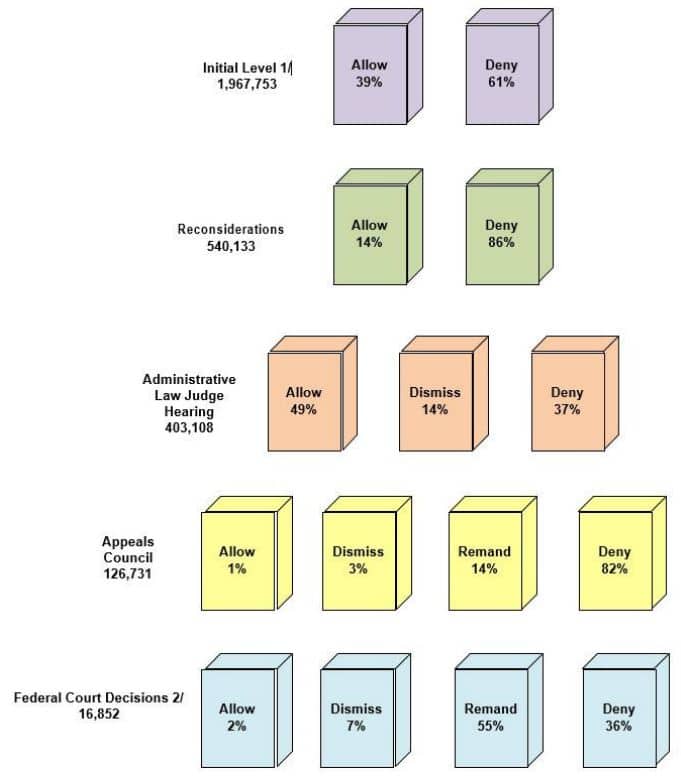
Chart depicting disability decision data and precentage chance of winning in social security disability claims

This chart shows the chances of success at the five major disability levels: initial, reconsideration, ALJ hearing, Appeals Council, and Federal Court. This represents general chances of winning, and is not divided into regions or law firm representation.

Source: 1) Initial and Reconsideration Data: SSA State Agency Operations Report; 2) Administrative Law Judge and Appeals Council data: SSA Office of Hearings Operations (OHO) and Office of Analytics, Review, and Oversight (OARO); 3) Federal Court data: SSA Office

Many of our litigation clients get confronted with inquiries about social media in the litigation process. Our modern society encompasses use of Twitter, Facebook, Instagram and other media without much thought. A quick picture, a comment, an invitation or a joke are generally considered harmless but one misstep can be seized upon by a savvy defense lawyer, and ruin your claim.

For example, you post a picture of yourself at a bar on the night you were harassed, or you joke about suing your employer in a Facebook post. Even if this was a joke, or you are celebrating your husband’s birthday, or just enjoying your private life, it could give grounds to dispute your claim of emotional distress damages.

In Georgel v. Preece, a 2014 federal court case, the employer asked for extensive social media information, including full URL, user names, passwords, school, networks, birthdays, email addresses, and passwords, for three years for Facebook, Myspace, Instagram, Snapchat, Twitter, Topix, and LinkedIn, along with photographs, videos, applications, postings, wall postings with comments, messages, friends lists, comments, tweets, etc. The Plaintiff argued the requests were overly broad. The Court noted that litigation discovery is broad, as opposed to trial evidence, and “it must first be stated that there is no dispute that social media information may be a source of relevant information that is discoverable. Courts have found, particularly in cases involving claims of personal injuries, that social media information may reflect a plaintiff’s emotional or mental state, his or her physical condition, activity level, employment, this litigation, and the injuries and damages claimed. The Court told the Defendant to narrow its discovery requests, allowed some of the requests, and seemed to split the baby down the middle. In Howell v. Buckeye Ranch, Inc., a federal case in Ohio (2012), the Plaintiff was required to produce social media data that was deemed relevant and ordered not to delete such data. Similarly, in Locke v. Swift Transportation Co. of Arizona, a Kentucky federal case in 2019, the Plaintiff had to produce information relating to physical activities or mental status for a six month period following the incident causing the lawsuit. Defendants analogized Plaintiff Locke’s social media activities to a diary containing information concerning her claims and her alleged injuries and damages.

Bottom line: be very careful about what you post if you are contemplating litigation, or even when seeking employment. Some or all of the social media content is discoverable, and often is taken out of context.

President Joe Biden on July 9, 2021 fired the head of the Social Security Administration after the official, who was appointed by former President Donald Trump, refused to resign.

The White House said the Social Security commissioner, Andrew Saul, “undermined and politicized” the agency’s benefits, among other things that warranted his firing. Saul’s deputy, David Black, who was also appointed by Trump, resigned on Friday at the White House’s request.

“Since taking office, Commissioner Saul has undermined and politicized Social Security disability benefits, terminated the agency’s telework policy that was utilized by up to 25 percent of the agency’s workforce, not repaired SSA’s relationships with relevant Federal employee unions including in the context of COVID-19 workplace safety planning, reduced due process protections for benefits appeals hearings, and taken other actions that run contrary to the mission of the agency and the President’s policy agenda,” the White House said.

Saul remains defiant and vows to fight the discharge. Upon being informed of his ouster Friday, Saul insisted that his firing was unconstitutional and threatened to sue.

Source: CNBC; Los Angeles Times

Our law firm has been relying on telephone and internet during the pandemic as a vital means of communication between client and attorney. We now have access to in-person meetings although many of you have voiced that telephone, zoom or skype communications are preferable. Our goal is to insure that we have clear, comfortable and convenient communications, and to give you choice. Let us know works best for you and your schedule. We are happy to accommodate in any way possible.

Please note our phone calls typically show our office number (216-621-2034). Sometimes, when working from home or over the weekend, our calls may appear from unknown or blocked numbers. We understand if you do not pick up one of these phone calls as there is so much spam-calling these days. However, we will leave a message, so please call us back, preferably during our working hours of 8am-6pm. After hours, a phone service is turned on. You may also email us at any time as well.

When individuals receive notice that their disability claim is suddenly being reviewed, and/or are being requested to attend an independent medical exam, confusion and fear sometimes occurs. While it is something you should not ignore, it does not mean that the claim will be denied or that your benefits will be disrupted. An independent medical examination can be an opportunity for you to provide important, relevant information to the LTD provider. This right to a medical exam emanates from a provision in the insurance policy with the insurance company.

Bear in mind that the idea that this is an “independent” examination is a misnomer. It is the LTD carrier that is deciding on the doctor to perform the exam, providing the questions to be answered by the doctor and paying the doctor. Often, a natural conservative bias results in conservative medical reports. With this in mind, here are some important steps that you can take to ensure a smooth process.

From a convenience viewpoint, initially confirm that the provider is within a reasonable distance to your location to attend the examination. “Reasonable” for purposes of an independent medical examination does not have a precise definition, but if it is more than 75 miles away from you, and traveling that far presents a challenge, you can ask to be provided with a consult closer to your home. The LTD carrier may fight about this, but with diligence, they usually can be convinced to find a closer consultative physician. Once there is an agreed upon provider, you need to confirm the date, time and location of the examination with the doctor performing the consultation. If you know you will not be available, do not delay, immediately contact the provider and the LTD carrier and request to reschedule the examination.

Clients frequently ask, “What should I know about this exam?” There are several things to be aware of. LTD carriers will often schedule surveillance of the claimant to occur the day before, the day of and the day after an IME as they are basically guaranteed to obtain footage of the claimant leaving their home. Therefore, you should treat this period of time as a prime opportunity to demonstrate your abilities and limitations. While you should always be operating within your restrictions, it is particularly important not to take any unnecessary risks or push outside of your limits during this window of time. Similarly, the day of the examination, and even before, you should presume that you are being observed from the moment you enter the parking lot of the building where the exam occurs, until the moment your vehicle leaves that same parking lot after the examination is over. This means that you may be observed in terms of how you exit your vehicle, whether you drove yourself, if you required a cane or walker to get from your car to the door of the building, etc. While in the waiting room, you can also assume that you are being observed. Consultative examination reports will often discuss whether a person was particularly social or loud while awaiting the exam, whether they were able to sit comfortably or were observed to be in pain, whether they had to leave frequently to use the restroom, etc. all before the actual examination ever starts. Once you are in the examination room, the assistant to the physician performing the exam and the actual physician will observe not only what you say and the clinical findings, but also your efforts, your demeanor and your physical abilities during the exam (i.e. did you have difficulty rising from a seated position, getting on and off the examination table, putting on and taking off your shoes, etc.).

All of this information is shared to show just how thorough the LTD carrier is in obtaining information to make a determination about your functional status. It is not simply a matter of what the doctor found when (s)he manipulated your knee or shoulder on exam. Additionally, prior to a consultative examination being scheduled, the LTD carrier often sends out an extensive questionnaire asking the individual to document their activities of daily living (i.e. what they do all day, what they can do, what they cannot do, what they require assistance with, etc.) Then, once the surveillance and IME are conducted, they will compare the information you provided on the questionnaire against the IME and surveillance information to determine whether what you said you could and could not do in your questionnaire is consistent with what was observed through surveillance and the IME.

There are a few specific recommendations that we typically make for how you can reduce risk, and help improve thee outcome in these situations. First, call us before – not after – the exam. Second, we recommend that you take copies of recent imaging (x-rays, CT scans, MRI’s, EMG’s, breathing tests, etc.) with you and give them to the IME provider. You dont need the actual x-rays etc, just the reports. The IME provider should have access to the medical record that the LTD carrier has, but it never hurts to insure they have the most important documents. Third, it may seem obvious, but do not be combative with the IME provider, and do not exaggerate pain. Nothing good will come from being disrespectful or hostile, and you can be assured that negative behavior occurs during an IME, it will be unfavorably documented in the IME report, and that report will become a part of the permanent LTD file. Similarly, many IME doctors are simply looking for an opportunity to show pain is exaggerated. Third, a great way to communicate how disabling your conditions are is to show how restricted your activities and lifestyle are. Let them know how difficult it is, for example, to fold clothes, or mop, or walk a block. Finally, and as always, stay off of social media. In the same way that being combative never helps, social media is almost always detrimental and a joke or a quip on Facebook can remove some of the legitimacy you have in your claim.